Best Cervical Pillow
for Side Sleepers
The best cervical pillow for side sleepers should fit the space between your head and mattress without making you fight its shape. Start with usable height, neck support and room to turn.
A deep dip, a tall neck roll or an orthopedic label cannot tell you whether a pillow will suit your shoulders. This guide compares three different approaches to contoured support, explains how to position each one and helps you decide whether an adjustable, fixed-foam or fiber-filled design makes the most sense for your bed.
Explore the three pillowsHow to read this guide: These are research-based selections, not hands-on test results. We checked manufacturer specifications and Amazon listings. Our selection process
Affiliate disclosure: This article contains Amazon affiliate links. As an Amazon Associate I earn from qualifying purchases. If you buy through these links, we may earn a commission at no extra cost to you.
THREE WAYS TO FIND YOUR FIT
The shortlist, at a glance.
Compare the fit, filling and trade-offs.
Save a pillow with the heart to revisit it later.

For adjustable contour height
UTTU Sandwich Queen
A removable middle layer gives you a practical starting point when you want shaped support but are unsure how much loft your mattress requires.
For a fixed, extra-firm contour
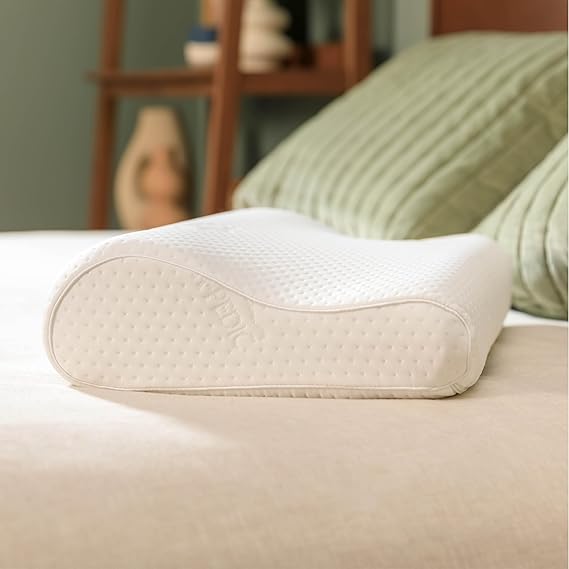
TEMPUR-Ergo Neck Medium
A compact, fixed contour for sleepers who want a more defined support surface and do not need to adjust the pillow after buying.

For a foam-free shaped pillow
Core Products Tri-Core Gentle
A fiber-filled alternative with raised side-sleeping areas and a recessed center for back sleeping, for those who do not want a solid foam core.
Product specifications and care sources reviewed October 15, 2026. Check current price, delivery eligibility, seller and return terms on Amazon. Buttons open Amazon in a new tab.
THE DETAILS THAT CHANGE THE DECISION
Compare the three pillows.
Start with the type of adjustment you want. Then compare the linked size, the part of the pillow you will sleep on and the return terms.
| What matters | UTTU Sandwich | TEMPUR-Ergo Neck | Tri-Core Gentle |
|---|---|---|---|
| Best fit | Trying different heights while keeping a conventional wave contour | Sleepers who want a defined contour and know they prefer a firm surface | Sleepers who prefer fiber and can use the dedicated raised side areas |
| Filling | Layered UTTU Dynamic memory foam; polyester/viscose cover | Single-piece TEMPUR-Material polyurethane foam; removable polyester knit cover | Polyester fiber fill; cotton/polyester cover; latex-free |
| Height / adjustment | 5.2 / 4.5-inch edges; 4.0 / 3.2 inches with middle layer removed | 4-inch nominal profile; no removable height-adjustment layer | Approximately 5-inch overall height; shaped center and raised sides |
| Linked version | Queen Size, White; current listing with 5.2 / 4.5-inch contours | Medium Profile, White; one pillow | Full Size, Gentle, White; single pillow FIB-220 |
| Listed dimensions | 23.6 × 13.8 inches; current Queen listing | 20 × 12.5 × 4 inches, approximately | 24 × 16 × 5 inches, manufacturer-listed Full Size |
| Main compromise | Adjustment is in layers, not tiny increments; older specifications differ | A precise size choice matters because you cannot remove filling or a layer | Position-specific shape, no removable layers; check delivery and returns carefully |
| Current offers | Check on Amazon ↗ | Check on Amazon ↗ | Check on Amazon ↗ |
These are unloaded product dimensions, not measured sleeping heights. UTTU figures refer to the current linked Queen listing; older manufacturer figures differ. Tri-Core’s overall height does not describe its recessed center. No standardized cross-brand firmness or cooling test was performed.
A CLOSER LOOK
Which one belongs on your bed?
Our reasoning, the trade-offs and a practical fit check for each pillow.
01 / For adjustable contour height
UTTU Sandwich Queen
Why it made the shortlist: a fixed cervical pillow can be an expensive guess when you have never slept on a contour before. UTTU gives you a second configuration inside the same pillow. That makes it our most flexible starting point here, although flexibility is not a guarantee that either setting will fit. It is particularly worth comparing if your current pillow feels acceptable at bedtime but you keep folding it or pushing an arm underneath later.
The linked Queen listing specifies two edges of 5.2 and 4.5 inches, reducing to 4.0 and 3.2 inches when the middle layer is removed. The older manufacturer page describes a different height range. We use the current linked version’s measurements, not a mixture of the two. Confirm the selected Queen option and the instructions on the delivered pillow before making your first adjustment. [1] [2]
The reason to choose this over a loose-fill pillow is its repeatable shape. You can compare a full-layer setup with a reduced-layer setup without trying to remember how much filling you removed. The compromise is that there is no fine-grained middle setting. If the lower configuration feels insufficient and the taller one pushes your head sideways, do not assume more nights will solve the mismatch. A different contour or adjustable-fill construction may be the better next step.
For side-and-back sleepers, test both positions before deciding which edge belongs nearest your shoulder. The setting that feels generous on your side may feel intrusive when you roll onto your back. Equally, a configuration chosen mainly for back sleeping can leave you wanting more support on your side. The useful question is whether you can change position naturally while remaining comfortable, rather than whether a product description lists every sleeping position.
The current listing identifies a 60% polyester / 40% viscose cover. Its cooling language does not establish how cool it will feel in your bedroom, and we have not measured temperature or foam compression. UTTU’s warranty page limits coverage to qualifying purchases, including authorized marketplace stores; we did not verify this seller’s authorization. Check the offer’s own terms rather than assuming a direct-store trial applies. [1] [3]
Reasons to consider it
- Removable middle layer offers a meaningful alternative height
- Two contour edges to compare during setup
- A shaped core without loose filling to measure or store
What to weigh up
- Neither layer configuration is guaranteed to fit
- Queen specifications differ from older manufacturer information
- Seller eligibility and returns need checking before purchase
Your fit check
Compare the full and reduced configurations on your own mattress, with your shoulder on the mattress. Keep the setup in which your head rests comfortably without tilting toward either shoulder; do not automatically choose the tallest edge.
Care & cleaning
The listing explicitly describes the removable pillowcase as machine washable. Treat that as a cover instruction, not permission to machine-wash the memory foam. Follow the supplied label for temperature, drying and core cleaning; ask UTTU if the instructions are unclear. Care instructions
02 / For a fixed, extra-firm contour
TEMPUR-Ergo Neck Medium
Why it made the shortlist: not everyone wants a pillow to rearrange. TEMPUR-Ergo Neck is the deliberate fixed-contour choice here. It makes most sense when you have already learned that a firm shaped pillow suits you and you want to compare a clearly specified profile. It is a less forgiving first purchase for someone who dislikes any noticeable pressure beneath the neck or prefers to scrunch a soft pillow into place.
The linked version is Medium Profile, approximately 20 × 12.5 × 4 inches. It is not the Large version featured in our broad-shoulders guide. Amazon calls its feel extra firm; Tempur-Pedic describes the range as firm. These are manufacturer and listing descriptions, not results from our own pressure or firmness testing. The difference matters if you interpret “memory foam” as automatically soft. [4] [5]
Its central trade-off is commitment to the contour. You cannot unzip the core and take out a small amount of filling when your mattress or posture changes. If the Medium is too tall or too low, the answer may be another size or another design. The manufacturer’s sizing guidance can help you narrow the options, but a measurement taken while standing cannot reproduce how your shoulder settles into your bed. [6]
We would compare it with UTTU on two questions: do you want an adjustment option, and do you already enjoy pronounced firmness? Choose TEMPUR for the latter preference, not because a higher price proves better support. For a restless sleeper, also consider its relatively compact footprint. Check that you can roll over without repeatedly leaving the useful area or dragging the pillow along with your head.
Tempur-Pedic’s direct-store pillow policy differs, so read the terms attached to the selected seller. We do not treat a brand reputation, warranty length or product name as evidence that this pillow will relieve your particular symptoms. [4]
Reasons to consider it
- Clearly specified Medium profile
- Defined contour for people who prefer firm support
- Removable washable cover
What to weigh up
- No layer or fill adjustment
- Extra-firm feel will not suit everyone
- Compact width may be limiting for sleepers who move widely
Your fit check
Check the Medium profile against the space you actually need on your bed. If you have to shift your shoulder onto the pillow, tuck your chin or move to its edge to become comfortable, reassess the size rather than forcing the position.
Care & cleaning
Remove the cover and wash it in cold water with mild detergent, following its label; hang drying is recommended. Do not wash or soak the TEMPUR foam core. Tempur-Pedic gives separate guidance for refreshing the foam. Care instructions
03 / For a foam-free shaped pillow
Core Products Tri-Core Gentle
Why it made the shortlist: cervical support does not have to mean memory foam. Tri-Core offers a substantially different construction from the first two picks. It is worth considering if your objection to a contoured pillow is the sensation of a molded foam surface, rather than the idea of a shaped sleeping area. We selected the Gentle Full Size version, not the separate Firm model, cooling version or a bundle with a therapy pack. [8]
The important setup distinction is where your head goes. Core Products identifies the raised side areas for side sleeping and the recessed center for back sleeping. A side sleeper who stays in the central dip may judge the wrong part of the pillow. Before ordering, decide whether you are comfortable with a design that asks you to change sleeping zones when you turn. Someone who wants the same broad, consistent surface everywhere may prefer a simpler profile. [9]
The Full Size is listed at approximately 24 × 16 × 5 inches, with polyester fill and a cotton/polyester cover. Gentle is described as medium firm; it is not a promise of a plush down-like feel. Support can be changed to a degree by redistributing the fiber, but this is not the same as removing a measured layer. Judge the feel of the particular zone beneath your head rather than comparing its maximum overall height directly with a foam pillow’s edge height. [9]
The trade-off is a more structured routine. If you tend to rotate in place without moving your head across the pillow, the change between center and raised side area may be inconvenient. If you are happy to reposition deliberately, the distinct areas may make more sense. This is an editorial fit consideration, not something we have tested overnight. Do not interpret an adjustment period as a reason to continue with increasing pain or pressure.
Buying caution: confirm the standalone pillow, its exact size, delivery eligibility and opened-item return restrictions with the current seller before payment. Choose it only if its fixed fit and purchase terms work for you; an unwanted bundle is not a substitute for the named configuration. [8]
Reasons to consider it
- A shaped option without a memory foam core
- Separate sleeping areas for side and back positions
- Gentle version provides an alternative to the Firm model
What to weigh up
- You need to use the appropriate sleeping zone
- Fiber redistribution is not precise removable-layer adjustment
- Location restrictions and a non-returnable notice warrant careful checking
Your fit check
Start on a raised side area while lying on your side, then check the center while on your back. If switching between them feels awkward or the side area cannot support you comfortably, a different shape may suit your habits better.
Care & cleaning
Core Products specifies hand washing in cold water with mild soap and drying flat. Do not machine wash or machine dry the pillow. Use a separate pillowcase for routine laundering and follow the label supplied with your exact version. Care instructions
FIT FIRST. FEATURES SECOND.
How to choose the best cervical pillow for side sleepers
A useful contour supports your preferred position without making you hold it. Work through height, shape and surface feel in that order, then check the purchase terms.
Mostly on your side
Start with the space your pillow needs to fill on your actual mattress. A taller outline is not useful if your head ends up tilted upward. A low center designed for back sleeping may not be the correct side-sleeping zone.
Side and back sleeper
Check both positions using the same setup. A pillow that is comfortable only when you carefully arrange it on your side may be frustrating if you turn onto your back several times a night.
A frequent position changer
Consider the width and transitions between sleeping areas. Think about whether you naturally move across the pillow or turn in place. This can matter as much as the difference between foam and fiber.
Hospital for Special Surgery emphasizes a neutral, comfortable neck position rather than bending the neck sharply in any direction. Pillow shape is one part of that setup, not a diagnosis or treatment plan. [10]
Check the height on your mattress
Compare pillows where you actually sleep, using your normal mattress topper and bedding. Your shoulder may sink more into one surface than another, changing the gap beneath your head. A broad-shouldered person is not automatically best served by the tallest available contour, and a smaller person is not automatically best served by the lowest. Treat product measurements as a way to narrow the shortlist. The final check is how the assembled pillow feels under your head after you settle, with your shoulder resting on the mattress rather than perched on the neck roll.
Separate neck support from head lift
A prominent roll can feel supportive beneath the neck while still lifting the head into an uncomfortable position. Look at the entire head-and-neck relationship, not just whether you can feel material touching the neck. HSS’s guidance favors a neutral position. As a practical check, ask whether you can relax without bracing your jaw, lifting your chin or curling tightly to fit the shape. If you need to hold a position to make the pillow work, reconsider the profile. [10]
Understand the contour before choosing a side
A wave contour, a butterfly shape and a recessed fiber pillow do not have identical instructions. There is no universal rule that the tallest edge must always face your shoulder. Read the orientation guidance supplied with the exact model. For the Tri-Core, the raised side areas are the relevant place to assess side sleeping. With a layered wave pillow, compare the permitted configurations rather than turning a shaped core into a makeshift flat pillow. Keep the supplied cover fitted as intended so the layers remain together.
Choose meaningful adjustability
Ask what can actually change. UTTU offers a removable middle layer. TEMPUR-Ergo Neck asks you to choose the profile at purchase. Tri-Core allows some fiber redistribution rather than a removable height insert. These are different kinds of control. If you are unsure of your loft, reversible layer adjustment is useful, but it still has limits. Do not buy a fixed pillow on the assumption that its foam will eventually compress to whatever height you need. Also consider whether you are willing to store an unused layer and repeat the fit check after changing it.
Match firmness to comfort, not a label
A firm cervical pillow is not automatically more effective than a softer one. Decide whether you prefer a defined surface, a slower conforming feel or fiber you can redistribute. A surface that feels impressive when pressed with a hand can feel quite different beneath an ear for a long period. We would reject a pillow that creates persistent pressure even if its dimensions look ideal. Brand-specific terms such as firm, extra firm and Gentle are not a shared measurement scale, so use them as descriptions rather than precise comparisons.
Test the positions you really use
Try your usual side, your other side and your normal back-sleeping position if you use it. Check whether you can turn without catching your shoulder under an edge or repeatedly searching for the right zone. Do this with your usual pillowcase because a tight case can change how an adjustable pillow sits. If you often finish on your stomach, a substantial cervical roll may be a poor compromise. Our side-and-stomach sleeper guide addresses that different height problem.
Keep temperature claims in perspective
A breathable cover can be a useful feature, but a cooling label does not tell you how the whole pillow will feel after hours in your room. None of these three has been temperature-tested by us. Consider the case, protector, bedding and room conditions together. A thick protective cover may also change the surface feel that attracted you to the pillow. If heat is your main reason for replacing a pillow, make it a separate buying criterion rather than assuming all cervical or bamboo-described pillows perform the same way.
Plan cleaning before you buy
Read the care instructions for the cover and the filling separately. A washable case does not make a foam core machine washable, while a fiber-filled pillow is not necessarily safe for a washing machine either. Tri-Core requires hand washing; TEMPUR separates washable cover care from non-washable foam. For UTTU, the listing clearly identifies the case as washable, so follow the supplied label for the rest. If your household needs frequent full-pillow laundering, this care requirement may matter more than a particular contour feature.
Make the return policy part of the decision
A pillow can match every specification and still feel wrong. Check the seller, selected variant, delivery eligibility and whether an opened pillow can be returned. Do not transfer a manufacturer’s direct-store sleep trial to an Amazon offer without verifying it. Save the relevant order terms for your own reference. This is especially important for the Tri-Core listing, which contained a hygiene-related non-returnable notice, and for marketplace sellers whose authorization under a manufacturer warranty has not been confirmed.
Know when the question is bigger than a pillow
If neck discomfort continues for weeks, you are worried about it, or you have symptoms such as pins and needles or a cold arm, seek medical advice rather than repeatedly buying new pillows. The NHS lists these as reasons to consult a clinician. A diagnosed condition, recent injury or surgery may require individual positioning advice. You do not need to demonstrate loyalty to a new pillow by tolerating worsening symptoms while waiting for it to feel normal. [11]
A simple decision rule
Start with UTTU if you want to compare layer heights, TEMPUR if you know you like a fixed firm contour, or Tri-Core if you prefer fiber and its separate sleeping zones. Keep only a setup that is comfortable on your own bed and works with the positions you actually use.
BEHIND THE SHORTLIST
How we chose these pillows.
We shortlisted three cervical pillows with meaningfully different constructions: an adjustable layered memory foam model, a fixed firm contour and a shaped fiber-filled model. Selection focused on usable height, orientation, ability to change positions, cleaning and purchase limitations. This is a researched buying guide; we have not slept on, measured or laboratory-tested these pillows.
We checked the exact Amazon variants and manufacturer information on October 15, 2026. The linked versions are UTTU Queen B079FK5QKD, TEMPUR-Ergo Neck Medium B07CMFSY97 and Tri-Core Full Size Gentle White B005RCBKE6. Product photographs are displayed from the previously recorded retailer image sources. Check the linked retailer page for the selected model and version. We did not use star ratings, advertising badges or customer anecdotes as evidence of medical effectiveness.
Where information differed, we identified the limitation instead of averaging conflicting numbers. UTTU’s current Queen listing gives different dimensions from an older manufacturer page. Confirm current delivery eligibility and opened-item restrictions for the exact Tri-Core option before buying.
Hospital for Special Surgery and NHS guidance inform the general neck-positioning and care-seeking advice. They do not endorse this shortlist. Terms such as cervical, orthopedic and ergonomic describe how products are presented; our selections should not be read as evidence that a pillow repairs spinal alignment, cures pain or treats a medical condition.
Sources & product checks 11 references · checked October 15, 2026
- UTTU Sandwich Queen — Amazon variant, dimensions, cover and offer
- UTTU — manufacturer product information (older dimensions)
- UTTU — warranty eligibility and authorized purchases
- TEMPUR-Ergo Neck Medium — Amazon variant and specifications
- Tempur-Pedic — TEMPUR-Neck sizes, construction and policies
- Tempur-Pedic — choosing a neck pillow size
- Tempur-Pedic — pillow cover and foam care
- Tri-Core Full Size Gentle White — standalone Amazon listing
- Core Products — Tri-Core construction, sleeping zones, sizing and care
- Hospital for Special Surgery — sleeping with neck pain
- NHS — neck pain and when to seek advice
BEFORE YOU CHOOSE
Cervical pillows for side sleepers: your questions answered
Straight answers about height, materials, care and buying on Amazon.
What is the best cervical pillow for side sleepers?
UTTU Sandwich Queen is our first option to compare if you want adjustable contour height. TEMPUR-Ergo Neck Medium is the fixed, extra-firm alternative, while Tri-Core Gentle Full Size provides a foam-free shaped option. None is universally best. Choose according to the height you need on your mattress, your preferred feel and whether you are comfortable using specific sleeping zones. Check the exact version and purchase terms before ordering.
What is a cervical pillow?
It is a pillow designed or marketed to support the neck, often using a raised roll, wave contour or recessed head area. It does not have to contain memory foam: Tri-Core uses fiber. The name alone does not tell you the height, firmness or correct orientation, and it does not establish that the pillow will treat pain. Read the model’s shape and instructions as carefully as its filling description.
Are cervical pillows good for side sleepers?
They can be a suitable bedding option when the contour fits comfortably. The shape needs to work with your shoulder position and mattress rather than dictate an awkward pose. Some side sleepers prefer a conventional adjustable pillow instead. There is no requirement to switch to a cervical design if your existing pillow is comfortable; a more elaborate outline is not inherently a better match.
Is a cervical pillow better than a regular pillow?
Not automatically. A regular pillow may give you more freedom to fold or reposition the filling, while a molded contour offers a more defined shape. The practical comparison is whether your head stays comfortably supported and whether you can turn naturally. If a cervical roll creates pressure you did not have with your old pillow, its specialized label is not a reason to keep using it.
What is the difference between cervical, contour and orthopedic pillows?
The terms overlap in product listings. Contour usually describes a shaped surface; cervical points to neck support; orthopedic labeling suggests a support-related purpose. Do not use those words as interchangeable proof of suitability. Compare the actual dimensions, construction and instructions. Two pillows with all three words in their titles may have very different heights and feel completely different on the same bed.
How high should a cervical pillow be for side sleeping?
There is no single inch measurement that fits everyone. Listed height is usually measured without your head resting on the pillow, and it may refer to the tallest edge rather than the area you will use. Shoulder sink into the mattress changes the space to fill. Start with a plausible profile, then assess the supported position on your own bed instead of treating a height chart as a final answer.
Should side sleepers use the high or low side of a contour pillow?
Use the orientation recommended for the specific model, then assess whether it is comfortable for you. The tallest edge is not an automatic prescription for every side sleeper. A petite sleeper on a yielding mattress may need a different setup from a broad-shouldered sleeper on a firmer surface. With UTTU, removing the permitted middle layer provides another configuration to compare.
Which part of the Tri-Core should I use on my side?
Core Products identifies its raised side areas for side sleeping and the recessed center for back sleeping. That makes it different from a uniform pillow where you can rest anywhere. If you routinely turn in place without moving across the pillow, consider whether those separate zones suit your habits. Review the positioning illustrations supplied with the exact model. [9]
Should my shoulder be on the cervical pillow?
For these ordinary head-pillow setups, begin with your shoulder on the mattress and the pillow supporting your head and neck. If you have to climb onto the pillow with your shoulder to make it comfortable, reconsider the size or placement. Follow any model-specific instructions, and use individual clinical guidance if you have been given a special positioning plan after an injury or procedure.
Can a cervical pillow be too high?
Yes, a profile can be unsuitable even when the material feels pleasant. If your head seems pushed away from the mattress or you keep shifting to a thinner edge, reassess the height. Try a permitted lower configuration if the pillow offers one. Do not solve a poor match by holding your neck in a position you cannot comfortably relax into.
How do I know if a cervical pillow is too low?
A repeated urge to fold it, add an arm underneath or stack another pillow can be a reason to review the setup, though those habits alone do not diagnose the problem. Compare how your head rests after you settle into the mattress. If there is not enough support in the area you use, consider a different allowed setting or a better-matched profile.
Is a firm or soft cervical pillow better?
Neither is best for everyone. Firmness describes surface resistance, while suitability also depends on height, shape and how the material responds under your head. TEMPUR is the intentionally firm choice here; Tri-Core Gentle should not be confused with a very soft conventional pillow. Avoid choosing maximum firmness simply because you want maximum support. Comfort under your ear and neck matters too.
Is memory foam the best material for a cervical pillow?
Memory foam is one option, not a requirement. Some people prefer a molded surface that conforms gradually; others want fiber they can redistribute or a different feel altogether. This shortlist includes Tri-Core specifically to offer a foam-free alternative. Decide which sensation you prefer, then compare dimensions and adjustment. A material preference cannot compensate for a contour that does not fit.
What is the best adjustable cervical pillow in this guide?
UTTU Sandwich Queen has the clearest removable-layer adjustment among these three. It lets you compare two assembled height configurations while retaining a wave-shaped surface. That is helpful when you do not yet know your preferred loft, but it is not infinite adjustment. If neither configuration is comfortable, consider another design instead of cutting foam or altering the core beyond its instructions.
Why do UTTU height measurements differ between websites?
The current linked Queen Amazon listing gives 5.2/4.5-inch contours and 4.0/3.2 inches with its middle layer removed. Older UTTU manufacturer information describes another range. We have not assumed those versions are identical. This guide uses the dimensions attached to the linked Queen option; check the selected size and supplied product information when ordering. [1] [2]
Is TEMPUR-Ergo Neck Medium the same as Large?
No. The linked Medium has an approximately 4-inch profile, while the manufacturer lists Large separately at approximately 4.75 inches. Our broad-shoulders guide discusses the Large version; this guide links Medium. Verify the size selector rather than relying on the shared product-family name. You cannot convert a fixed Medium core into the Large profile by rearranging its filling. [5]
What should broad-shouldered side sleepers look for?
Pay particular attention to usable height after settling into the bed, but do not order the tallest pillow solely from shoulder width. Mattress firmness and your preferred sleeping position also change the fit. An adjustment option can help you compare setups. Our broad-shoulders guide offers a separate shortlist if a higher-support setup is your main concern.
What about petite side sleepers or a soft mattress?
Compare lower profiles carefully and avoid assuming that a full-size or Queen label describes loft. Those names often refer to the pillow’s footprint. A deep contour may feel intrusive even if the length and width look appropriate. UTTU’s reduced configuration is one option to assess, but it may still be too high for you. Return flexibility is especially useful when you are unsure.
Can one cervical pillow work for side and back sleeping?
Possibly, but check both positions before committing. A profile that is comfortable on your side may feel excessive on your back. Tri-Core uses different zones, while the other two use a wave contour. Your turning habits matter: assess whether you can reach the appropriate area without repeatedly waking to reposition. See our side-and-back sleeper guide for a broader comparison.
Can I use a cervical pillow if I sometimes sleep on my stomach?
A substantial neck roll may be a poor compromise for that habit. Do not assume that a listing mentioning stomach sleeping means every height will work for it. HSS discusses the sustained neck rotation involved in stomach sleeping. If you regularly alternate between side and stomach, compare lower and adjustable options in our dedicated guide instead of starting with the tallest contour. [10]
Will a cervical pillow stop neck and shoulder pain?
We cannot promise that. Pain can have causes beyond a pillow, and none of these products was clinically tested by us. Choosing a comfortable setup is different from treating a diagnosed condition. If symptoms persist or concern you, seek medical advice. Our neck-and-shoulder guide addresses bedding fit without treating a product as a cure.
Do cervical pillows correct posture or restore the neck curve?
Do not assume that a retail product can permanently correct posture or restore a spinal curve. Manufacturer language about alignment is not proof of that outcome for you. In this guide, support means a practical sleeping fit, not a structural medical correction. Ask a qualified clinician about a diagnosed problem or any prescribed positioning device rather than choosing from a marketing claim.
How long should I give a new cervical pillow?
Use the return window and manufacturer instructions as practical boundaries, but do not set a rule that you must tolerate discomfort for a fixed number of nights. First check orientation and permitted adjustments. If the pillow produces increasing pain, pressure or worrying symptoms, stop using the problematic setup and seek advice when appropriate. An unfamiliar feel and worsening symptoms should not be treated as the same thing.
What if the cervical roll presses into my neck?
Recheck the pillow’s orientation, profile and the location of your shoulder. If a permitted lower setting is available, compare it. If pressure remains, the contour may simply be wrong for you. A support feature should not require you to endure a painful ridge. Avoid adding improvised neck rolls or stacking shaped pillows to rescue a design that does not feel comfortable.
Can a cervical pillow be comfortable under my ear?
It depends on the surface and your sensitivity. A firm contour can be acceptable beneath the neck yet unpleasant against the ear. Do not judge the pillow only by a quick hand press or its advertised support. If ear pressure is your main concern, compare purpose-designed options in our ear-pain pillow guide rather than assuming every contour has an ear recess.
Do cooling cervical pillows stay cold all night?
We have not verified that claim for any pillow here. A breathable or cooling-described cover is not a measured guarantee of overnight temperature. Your case, protector, room and bedding also affect the experience. Evaluate temperature separately from fit, and avoid trading a comfortable height for a cooling label whose performance has not been established for your conditions.
Can I use a normal pillowcase?
Check the product dimensions and the manufacturer’s recommendation. Tri-Core Full Size is described as fitting a standard pillowcase. With any shaped pillow, avoid a case so tight that it distorts the contour or bunches the layers. Keep the supplied protective cover in place unless the instructions say otherwise, and reassess comfort with the actual case you intend to use. [8]
Can I wash a cervical pillow in the washing machine?
Read cover and core instructions separately. TEMPUR’s foam core must not be washed, even though its removable cover can be. UTTU’s listing explicitly identifies the pillowcase as machine washable; follow the supplied label for the foam. Tri-Core is hand-wash-only despite its fiber filling. Do not assume that material category alone determines cleaning. [7] [9]
Can I return these pillows after trying them?
Do not assume so. Check the exact Amazon seller, your destination, opened-item restrictions, return eligibility and any costs before paying. A manufacturer’s direct-store trial may not cover a marketplace purchase. Resolve unclear terms with the seller before opening or using the pillow.
When should I get medical advice instead of buying another pillow?
The NHS advises seeking help if neck pain does not improve after a few weeks, if you are worried, or if other symptoms occur, such as pins and needles or a cold arm. Follow your clinician’s specific instructions for an existing condition or recent surgery. A shopping guide cannot determine the cause of your symptoms, and changing pillow height should not delay appropriate assessment. [11]
Still deciding? Start with the fit.
Choose the simplest contour that fits comfortably: adjustable layers if you need to experiment, a fixed firm profile if you know what suits you, or fiber if you prefer that feel. Confirm the exact variant and return terms, then judge the pillow on your own mattress.
Back to the three pillows